Rekindling the Flame: The Crucial Role of Prescribed Burns in Restoring and Maintaining Newaygo County’s Native Ecosystems

Prescribed Burn Training Scheduled for March 9th, 2024
10:00 am to 3:00 pm
@ Brooks Township Hall
(Free & Lunch Provided)

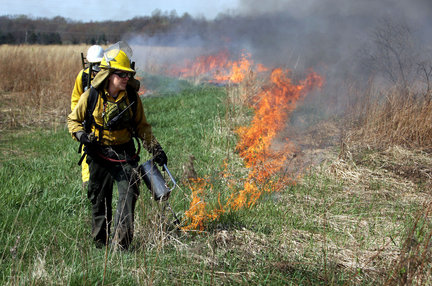
Newaygo County is home to a diverse range of ecological environments, including prairies, barrens, savannahs, and mature forests. These landscapes have been shaped by the natural occurrence of wildfires over thousands of years. However, as fire is often seen as a destructive force, the use of controlled burns, known as prescribed burns, is underutilized as a management tool.  Prescribed burns are essential in maintaining and restoring native ecosystems in Newaygo County which currently doesn’t have many individuals who can carry out the needed work.

Historical Significance:
For centuries, tall grass prairies and open brushlands in Newaygo County were kept free of trees by periodic wildfires caused by lightning or intentionally set by Native Americans. These fires played a crucial role in clearing the landscape, promoting the growth of fruit-bearing shrubs and forage-producing grasslands while controlling the spread of woody plants. Prescribed burns aim to replicate this natural process and its benefits.

Benefits of Prescribed Burns:


1. Nutrient Recycling: Prescribed burns help recycle nutrients tied up in old plant growth, allowing for the rejuvenation of the ecosystem.

2. Vegetation Control: By controlling woody plants and herbaceous weeds, prescribed burns create space for native grasses and wildflowers to thrive. This improves the overall quality of forage and increases plant growth.

3. Fire Risk Reduction: By reducing the accumulation of flammable materials, prescribed burns help mitigate the risk of large wildfires. This is particularly important in areas where human settlements interface with natural habitats.

4. Wildlife Habitat Improvement: Prescribed burns play a vital role in improving wildlife habitat. For example, brushlands can be invigorated and maintained with fire to benefit species such as bluebirds and sharp-tailed grouse. Burning old fields also controls saplings and woody vegetation, creating favorable nesting habitats for various wildlife species. Additionally, forest openings can be manipulated with burns to benefit more than 150 wildlife species.

5. Native Species Promotion: Prescribed burns can be used to promote the growth of fire-dependent trees, such as Jackpine, and increase populations of threatened and endangered species. They also help reduce the dominance of invasive and noxious weeds, allowing native wildflowers to flourish.

Prescribed burns are a vital management tool for maintaining and restoring native ecosystems in Newaygo County. By replicating the natural occurrence of wildfires, prescribed burns help recycle nutrients, control vegetation, reduce fire risks, enhance wildlife habitat, and promote the growth of native species. Through community involvement and training, we can ensure the long-term sustainability of these unique ecological environments. Let us embrace prescribed burns as a means to preserve the natural heritage of Newaygo County and create a harmonious balance between human habitation and the environment. 

Prescribed Burn Training:
To further the cause of prescribed burns in Newaygo County, the Newaygo County Environmental Coalition, in collaboration with the Michigan Nature Association and Big Bluestem Farm, will be offering the first Newaygo County prescribed burn training. (Keep in touch for the posting of this event.  We think it’ll be late March, 2024.) 


The objective is to form a trained group of volunteers who can perform prescribed burns under the guidance of specialists. This initiative aims to maintain existing nature preserves and assist homeowners in developing native landscaping on their properties.


Connected Resources:

Leave a Reply

Your email address will not be published. Required fields are marked *

Get In touch

Birds eye view of green forest meeting blue lake background. White NCEC logo and font.

(231) 519-3419

Address: 490 Quarterline St, Newaygo, MI 49337

Email buzz@nc-ec.org

More Posts:

Tim Duffy: Champion of Vernal Pools and First Wood Frog Award Honoree

Tim Duffy of Newaygo, Michigan, has been honored as the first recipient of the Wood Frog Award by the Michigan Vernal Pool Patrol for his outstanding contributions to vernal pool conservation. The award ceremony took place on August 23, 2025, at the Kropscott Farm and Environmental Center during the MI Vernal Pool Patrol – Newaygo Region’s Fall Training and Pool Party. Attendees enjoyed informative sessions on identifying fall vernal pools, shared stories, and explored the Kropscott woods to observe a dried vernal pool.

Read More »

I’m Dreaming of a GREEN Christmas

Every year during the holiday season, we’re surrounded by messaging about what gifts we should buy, what decorations we should put up around the house, what festive traditions we should continue or start, what we should wear for all those holiday parties, and a million other ways to make this grey-skied time of year seem more fun, more glamorous, or more fulfilling than the years before. Sometimes it seems that the shopping lists can trail on and on and the stress of getting everything together in time can put us in a sour mood.

During this time of year, many of us want to make space for connection with loved ones and reflection on the year behind us. Why then are we spending time and money in ways that fall short of helping create the connection and spaciousness that we really want?

Read More »

Fall Cleanup with Pollinators in Mind

The late-August chill prompted me to start thinking about fall clean-up in the garden. For many of us, tending our vegetable and flower beds, wild corners, and lawns will still be part of our rhythms in the months ahead as we prepare for winter’s rest.

Autumn is the perfect time for planting new perennials, dividing crowded clumps, and scattering seeds that need the cold season to wake them in spring. Yet as the chore list grows, so does another question: how do we balance our own labors with care for our other-than-human neighbors who share these gardens as food pantries, nurseries, and shelters?

Read More »