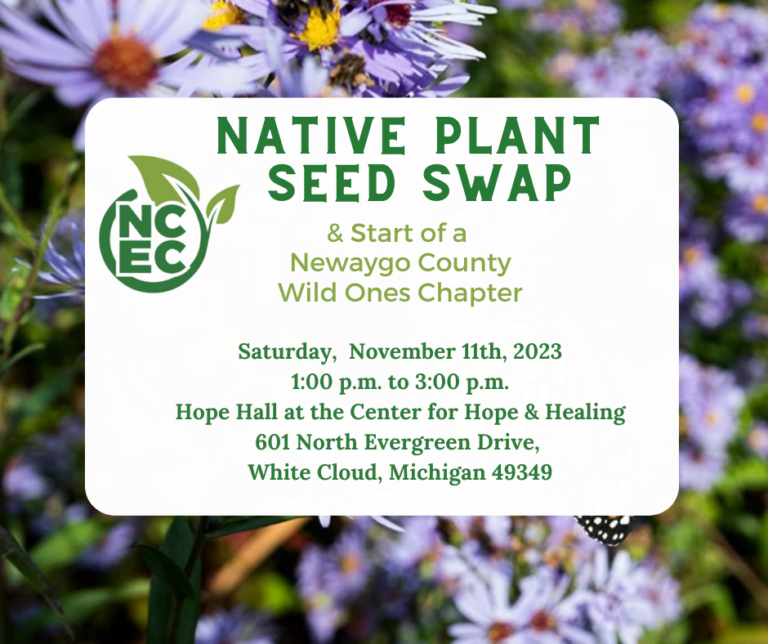
1st Annual NCEC (Newaygo County Wild Ones Chapter) Native Plant Seed Swap
November 11th, 2023
1:00-3:00 p.m.
The Center for Hope and Healing
601 North Evergreen Drive, White Cloud, Michigan 49349, United States
A Native Plant Seed Swap and Wild Ones Chapter discussion will occur on Saturday, November 11, from 1 p.m. – 3 p.m. The free event will be held in Hope Hall at the Center for Hope & Healing, White Cloud, 49337. Guests are encouraged to collect native plant seeds from their yards & gardens to share with others.
“We want to spread native plants around our county to help support our pollinators and wildlife. And what better way than to share free seeds with other homeowners!” states Katie Clark of the Newaygo County Environmental Coalition (NCEC).
“We will also discuss the possibility of starting a Wild Ones Chapter in Newaygo,” added Sally Wagoner of NCEC. “Wild Ones is a national non-profit that promotes the preservation of biodiversity through increasing native plant communities. There are chapters all around Michigan, but the closest one to us is in Grand Rapids.”
“The number of community members interested in native plants is growing rapidly. We think the time is right to start a Wild Ones chapter here,” Ms. Wagoner added. “A Wild Ones affiliation will provide information and resources on growing native plants, as well as assure camaraderie among native plant enthusiasts here.”
According to Katie and Sally, there are instructions on how to prepare your seeds for the seed swap:
Make sure the seeds you collect are dry. Collect them on a dry day, then spread them out in a dry area or put them in paper bags to dry. Don’t forget to mark the bags!
Separate your DRY seeds from the plant material.
Enclose the seeds in an envelope no larger than letter size (one species per envelope).
Write on the envelope:
o Common name
o Latin name (try to identify the correct species)
o Brief Description and when it blooms
o Sun/Shade
o Soil type Wet/Dry
o Your name
Bring a few envelopes of each seed type if you are able. You don’t need a lot of seeds per envelope.
If you only have enough of a species for one envelope, that is fine. If you do not have any seeds to share, that is fine too.
Guests are invited to attend even if they do not have seeds to share. Registration is encouraged, but walk-ins are welcome. To register, click here: Seed Swap & Wild Ones Chapter.
Questions? Email: buzz@nc-ec.org. For information about Wild Ones, go to www.wildones.org.
NCEC is a 501c3 non-profit that endeavors to be the environmental resource hub and to support the beauty and sustainability of Newaygo County and the region. Learn more at www.nc-ec.org.