
Returned and Restored
A cloud of road dust blanketed the car behind me from my excited acceleration as I passed the Newaygo Prairie Nature Sanctuary. Ignition time was in less than an hour. This was my very first burn.
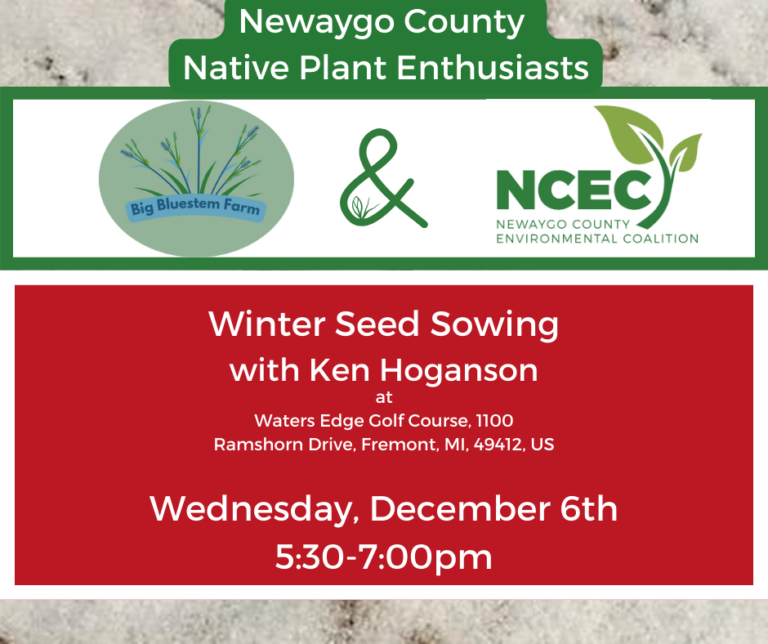
How to sow native plant seeds in winter for spring growth will be offered on Wednesday, December 6, 5:30pm – 7:00pm. This hands-on demonstration will be hosted by Big Bluestem Farm and the Newaygo County Environmental Coalition (NCEC) and will take place at the Waters Edge Golf Course – Lakes Restaurant, 1100 Ramshorn, Fremont, MI 49412.
“Many native plant seeds need the cold weather of winter in order to germinate in spring,” states Ken Hoganson of Big Bluestem Farm. “We will demonstrate how you can easily sow seeds in reusable household containers so you can grow the native plants that you want in your garden and yard.”
Michigan native plants are naturally adapted to live in a Michigan climate, which brings periods of freezing temperatures, Ken explains. For optimal germination many types of native seeds require exposure to cold, moist winter conditions alternating with the warming spring sun in order to germinate and grow well. This process is called “stratification”.
The program will include a discussion on the importance of native plants to our local ecosystems, what winter sowing is, and the benefits of the process. There will be demonstrations on the types of common household containers that are suitable to use as “mini-greenhouses” for the seed sowing.
“We may have some native plant seeds to give away,” adds Sally Wagoner of the Newaygo County Environmental Coalition. “We have some left over from the November Seed Swap. This is a great opportunity for folks to go home with some native plant seeds, turn their plastic milk containers into mini-greenhouses, and get ready for spring planting!”
Big Bluestem Farm is a native plant nursery near Bitely that specializes in native plants and an expanding “seed bank”. Ken and Shelly Hoganson grow dozens of different species of native plants providing plugs, quarts and gallons for gardens and installations by appointment. They also offer sales at some of the spring and summer native plant sales in the region.
Also on the agenda for the evening will be information about Vernal Pools Monitoring, and the Wild Ones Newaygo Region chapter in development. Katie Clark of NCEC is the local field coordinator for the Vernal Pools Partnership. These elusive spring ponds are highly important to our local ecosystems, yet they are not recognized or identified very much in Newaygo County. Ms. Clark will discuss how community members can become “citizen scientists” this coming spring in the Vernal Pools Monitoring Workshop. This will add Newaygo County and its vernal pools data to the national map.
“Wild Ones: Native Plants, Natural Landscapes” is a national non-profit that promotes environmentally sound landscaping practices to preserve biodiversity through the preservation, restoration and establishment of native plant communities. “There is a growing interest in native habitats and native plants in Newaygo County, so we are in the process of developing a local Wild Ones Chapter. This will benefit both our community members as they pursue native plants in their yards & gardens, as well as our unique native habitats throughout the County,” explains Sally Wagoner.
Registration for the Winter Seed Sowing program is recommended, although walk-ins can be seated as well. The event is free, with food and beverages the responsibility of attendees. To register click here: Winter Seed Sowing. Or you can email buzz@nc-ec.org. Visit the Newaygo County Environmental Coalition website calendar to view and register for this and other upcoming events in the region: www.nc-ec.org.
For more information about winter seed sowing and native plants, contact Ken Hoganson: khogansonjr@gmail.com, 630-915-7715.
Address: 490 Quarterline St, Newaygo, MI 49337
Email buzz@nc-ec.org

A cloud of road dust blanketed the car behind me from my excited acceleration as I passed the Newaygo Prairie Nature Sanctuary. Ignition time was in less than an hour. This was my very first burn.

“Vernal Pools are like our Coral Reefs of the Forest,” states Katie, Vice Chair and Program Manager of the Newaygo County Environmental Coalition (NCEC). “They are small, important wetlands that appear in spring and dry up during the fall. They are ideal breeding grounds for a variety of amphibians and invertebrates that would be vulnerable to lake or stream fish; the fairy shrimp, wood frogs, spotted and blue-spotted salamanders can only breed in Vernal pools. They even travel back to their birth Vernal pool to spawn.”

As humans, it makes sense that we often think of the Earth from our own point of view. We imagine it as a place with trees and meadows and houses and highways. We think of cities as places for people, roads as ways to get from one place to another. But this is only our experience, and there are about a billion others.