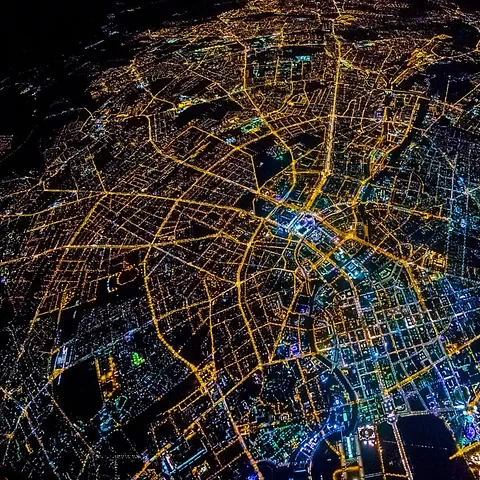
If you’ve ever been on an airplane at night and seen a lit-up city from the sky, perhaps you’ve also been enraptured by the way that our human-built-landscape seems to take on a new character when viewed from above. Once, when flying out of Ft. Myers, Florida, I was particularly struck by this cartography of radiant lines etched into the darkness.
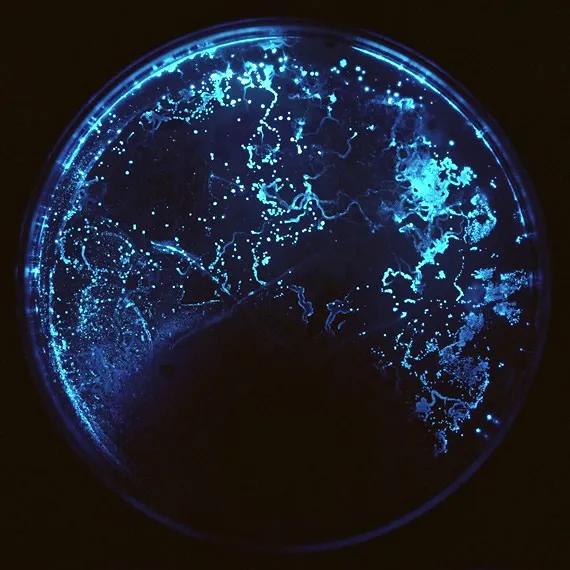
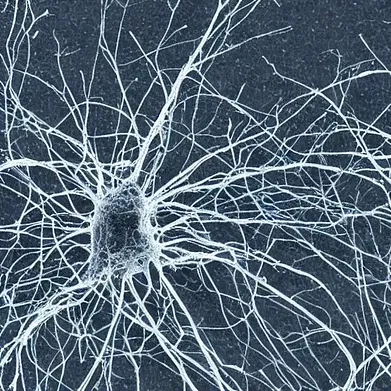
Since the city is built right on the coast, the light grid is forced to contort itself around the dark, amoebic shapes of lakes and mangroves and along the winding, meandering curve of the coastline. In some places, it seemed as though civilization were floating upon the amorphous dark mass of the ocean and inland tidal flats. Looking out the airplane window, I couldn’t help but being put in mind of other ways that life organizes itself: the outward creep of microbial growth from an epicenter, or the sprawling dendrites of a neural network.
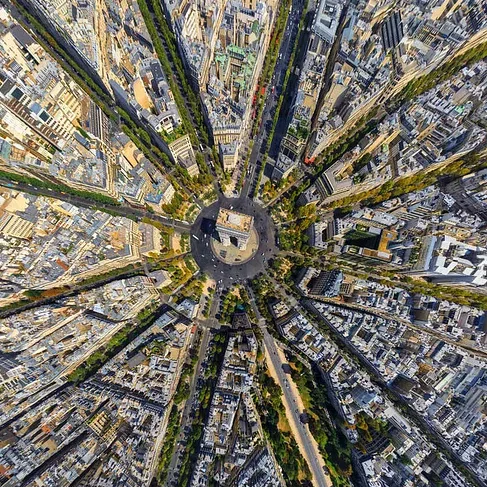
As humans, it makes sense that we often think of the Earth from our own point of view. We imagine it as a place with trees and meadows and houses and highways. We think of cities as places for people, roads as ways to get from one place to another. But this is only our experience, and there are about a billion others. Think about a bird soaring over the same city. It doesn’t see streets and buildings in the same way we do; it sees a landscape of food sources, nesting sites, and safe places to rest. For the bird, a tree is not a large ornament growing up from the ground, but a 3D maze of spaces between branches. And what about the mycorrhizal fungus that lives beneath that tree’s roots? Maybe to that fungus, the world can be described as a collection of chemical signatures. Each creature has its own “map” of the world, a unique way of understanding its surroundings. And each and every perspective is just as real as another.
Recently, I was talking with a friend who works for a company that sells this algae to farmers as a natural way to protect crops from pests, replacing harmful chemicals. She told me that they’ve recently been discovering some incredible results in terms of how effective the algae is at increasing farmers’ yields. Despite being invested in promoting this more sustainable form of pest control, she also struggles with how the algae gets talked about in a business context, as a “product” to promote. We laughed about how ridiculous it feels that this life force that has spent millions of years evolving its way of life. It has these intricate symbiosis with other plants and to the insects in the ecosystem, and here we are as humans advertising this algal intelligence at 10% off and measuring our quarterly earnings.
We often treat the natural world at worst as something to be used for our benefit, or at best something to be protected and preserved so that future generations of humans can continue to enjoy it. But beyond these limited perspectives, there are a billion other ways of telling the story.
Just like the city lights looked like different things from the sky, the earth itself is a multi-layered experience. It’s a network, a living system, a collection of stories told from countless points of view. This Earth Day, I invite you to open your mind and try to see the world through the eyes of others, and appreciate the incredible diversity of life that shares this planet with us. All it takes it a few moments to slow down, watch, and listen. See if you can catch a glimpse of the way some other creature on earth is experiencing the world around them. Perhaps it will give you a new perspective for yourself.