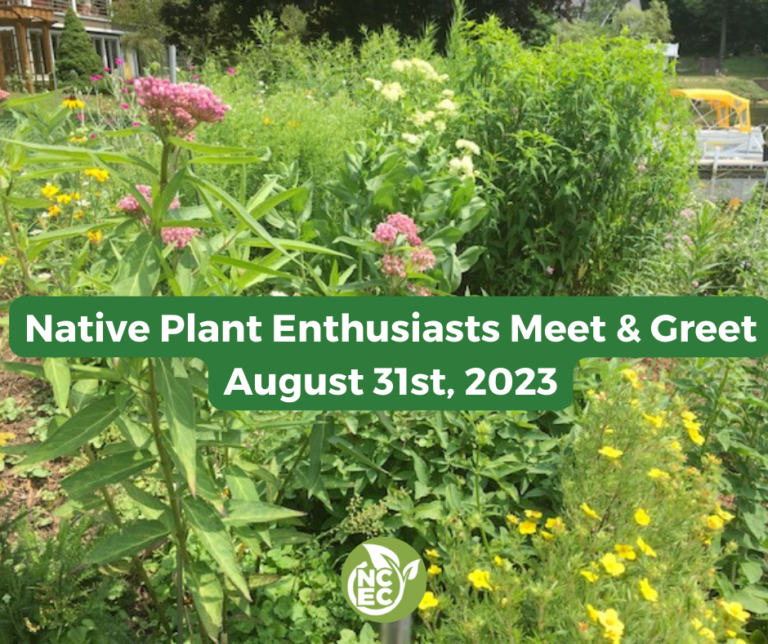
You too can be part of the “Homegrown National Park” Movement!
Native plant gardeners, preservationists and other native plant “nerds” are invited to come together on Thursday, August 31 for a first-time networking event. The informal gathering will be held at Waters Edge Golf Course, 1100 Ramshorn Drive, Fremont, MI 49412. Come at 5:30 pm and enjoy appetizers, dinner or drinks on your own while sharing interests, information and resources with others.
The gathering is hosted by Big Bluestem Farm and the Newaygo County Environmental Coalition. Experienced native plant gardeners and large area installers, as well as insect pollinator experts, will be on hand to share, and to answer questions you may have.
A focus of the discussions will be the “Homegrown National Park” movement.
What is the Homegrown National Park movement? It is a grassroots call-to-action to regenerate biodiversity and ecosystem function by planting native plants and creating new ecological networks.
According to Doug Tallamy, originator of the Homegrown National Park concept, we are at a critical point of losing so many species from local ecosystems that their ability to produce the oxygen, clean water, flood control, pollination, pest control, carbon storage, etc. (the ecosystem services that sustain us) will become seriously compromised.
As Doug explains, “Our National Parks, no matter how grand in scale are too small and separated from one another to preserve species to the levels needed. Thus, the concept for Homegrown National Park: a bottom-up call-to-action to restore habitat where we live and work, and to a lesser extent where we farm and graze, extending National Parks to our yards and communities.”
Doug Tallamy’s answer is a SOLUTION BASED ACTION – small efforts by many people:
“… what if each American landowner converted half of his or her yard to productive native plant communities? Even moderate success could collectively restore some semblance of ecosystem function to more than 20 million acres of what is now ecological wasteland. ”
According to the Homegrown National Park website map, there are currently 109,610 planted area acres of the 20 million acre goal. You can add your own native garden or acreage to the Living Map by going to: www.map.homegrownnationalpark.org.
Let’s get Newaygo County and all of West Michigan on the Homegrown National Parks map!
Come to the August 31 Meet & Greet to build our local network of Homegrown Parks. Let’s brainstorm together to create a native plants guideline for our neighbors, towns, townships and county. Together we can reclaim the biodiversity we need for a healthy planet.
Connected Resources: