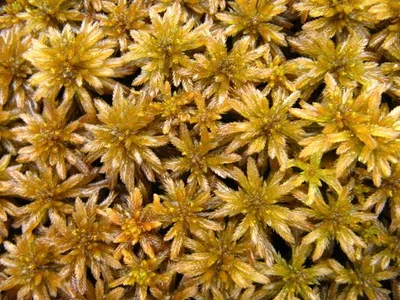
One of my favorite childhood memories is going on the Wetland Trail at Camp Newaygo. The trail is a walk through a sphagnum moss bog and, as far as I was concerned, a bottomless lake covered by land and large skeleton trees. It was absolutely terrifying. Once, my dad, taking a family picture, backed up too far and fell in! He did not get sucked under by the souls of trees and ancient monsters of the deep but did get quite wet! During the pandemic, I was sure to bring my children to the wetland trail, experiencing my own slip and slide and “near death” experience for them. Since the recent fire decimated the wooden trail, I have been spurred on to learn more about the sphagnum moss bog that the Wetland Trail tours and its place in our ecosystem.
A sphagnum moss bog is a waterlogged wetland ecosystem. Every wetland is not a bog, but every bog is an intricate and specific type of wetland. Bogs are unique in that their waterlogged, low oxygen levels and acidic conditions prevent full decomposition of plant materials, resulting in organic matter buildup over thousands of years. As dead plant material piles up, it creates layers of peat, with sphagnum moss often serving as the main component. Other plants that are found in bogs include shrubs and sedges.
Sphagnum moss is soft and spongy because of how much water it can contain, but it feels brittle and fragile whenever it dries out. Its ability to retain water (20 times its dry weight!) makes it a popular material for various garden, agricultural, and animal husbandry uses. The moss grows in large carpets over kettle lakes and depressions. Kettles are the remnants of large ice chunks left behind by retreating glaciers, leaving behind large holes and depressions filled with water. Almost all the lakes in Michigan’s lower peninsula are kettle lakes or swamps. Emerald Lake, Crystal Lake, and Fremont Lake are all examples of local kettle lakes in Newaygo County.
As the sphagnum moss becomes established, the water becomes oxygen-poor and acidic, preventing the complete decay of organic matter. This creates layers of peat, creating peatlands or a bog, in two ways: lake-filling and paludification. Lake-filling occurs in small lakes with minimal wave action, where gradual peat accumulation results in the development of a bog mat that can fill the basin or occur as a floating mat or grounded mat. Paludification is the blanketing of terrestrial systems (often forests) by the overgrowth of peatland vegetation. Paludified peatlands develop on flat areas (typically lakeplains) where peat develops vertically and spreads horizontally. In both cases, the layering and vertical growth of the soggy sphagnum moss and peat raises the land above the water table, preventing groundwater from mixing in and interfering with the anaerobic (low/no oxygen) conditions.
As long as there have been bogs and humans, they have been used for various purposes. Around 7% of Michigan’s land contains a bog, while peatlands comprise about 2.84% of Earth’s surface; 16% of that, or 0.5% of Earth’s land surface, has been drained for human use. Bogs store and sequester more carbon than any other type of land ecosystem. Peat or bogs are essential to capitalism, farming, and the environment. Many people and groups are working to find a safe, responsible, and sustainable way to use the bog wetlands. To learn more about this, visit the International Peatland Society’s website. To learn more about Michigan’s bogs, visit the Michigan Natural Features Inventory website.
These paragraphs only touch on the science and importance of bogs, peatlands, and sphagnum moss. One point of hope I took away from my research is that fires like the one at the Wetland Trail at Camp Newaygo are typical and can benefit the bog ecosystem. The fires are difficult for me, the visitor, as I now cannot experience the bog and its wildlife for the time being. I hope I will be able to walk through there again, and I look forward to telling my grandchildren someday about the time Great Grandpa fell into the bottomless lake (sources tell me it’s only about 80 ft deep).
Would that darkness could be worn like a cloak
wrap me in its unknowing
and its still quiet grace
This is a thick dark that lingers on me like
humidity
or the slow breath of someone I love sleeping against my neck.
Too much,
the burden of the day
which asks to see it all, like the bottom of the lake through clear water
Within my watery bones
are murky half-truths
Sediment settles
into
layers
of
revision
slowly
de
scend
ing,
I am a cranberry bog
pulsating with anaerobic decay
My bones dissolve and disintegrate
shake and bend and crumple
a pile of clothes on the floor
a lean-to buckling into dust
Heavy now the dark falls down.
Let us cast away the speech of running motors
On and on engines will rumble and burn
Their drone the hymns I no longer sing
Such speech is a gluttonous clanging of bells
resounding with their fear of the dark
So weary of speech
except to say I sleep a lot these days
and to say I am now aching deeply for the running of red maple sap lines and those first furls of skunk cabbage