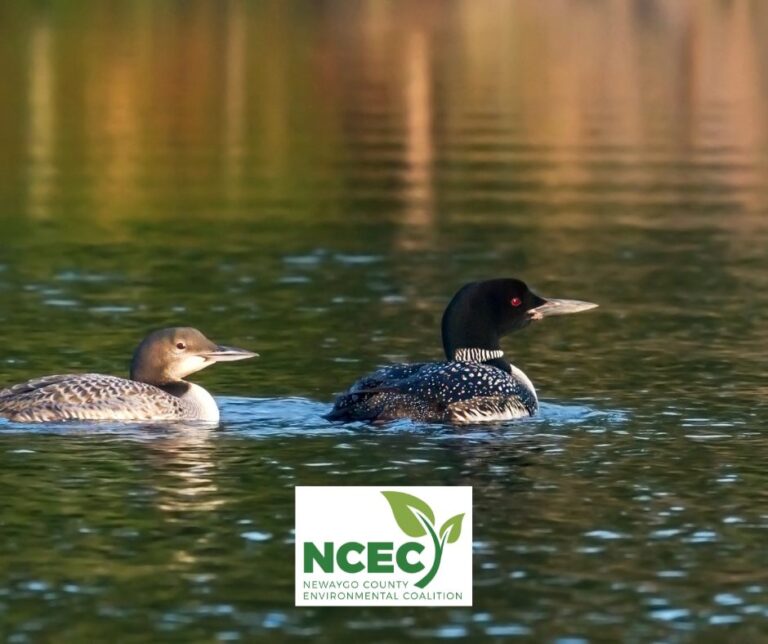
The first time I saw the movie, ON GOLDEN POND, I knew I wanted to one day live on a lake where I would listen to the beautiful call of the loon. When my husband and I started to look for a place to retire, we found a small lake in Newaygo County, Petit Lake. Just out from the beach on the lot we were thinking of purchasing, swam two loons. I knew this was where I wanted to live.
Now, 7-years later, I’ve been assigned the lake’s Loon Ranger. No, this isn’t a joke. Pettit Lake has become a member of Michigan Loon Preservation Association, which is a non-profit organization “whose mission is to preserve the Common Loon as a breeding bird in Michigan through public education, research, and the protection and management of loons and their habitat”.
Did you know that Michigan loons are endangered? There is an estimated population of less than 500 loon pairs. Unfortunately, the development of homes on lakes lead to the elimination of nesting places for loons and the use of motorized watercraft can scare them away. However, we at Pettit Lake have decided to be a part of the LOON WATCH. We have large areas of natural lake shoreline and commit to keeping a safe distance from the loons when out enjoying the lake.
Check out the protocols we are taking to protect our loon pair:
-Observe loons from a distance at least 200 feet (2 cottonwood trees on end) away. Stay even farther from the nesting area; always low wake as to not disturb the nest or make the parents afraid.
-Disturbances can cause the adult loons to abandon the nest, leaving the chicks to die.
-If a loon acts disturbed when you are near it-calling, splashing, coming out of the water with wings held wide, get away!
-Never leave fishing lines unattended and stop fishing if the loons are feeding in your area. NEVER throw tangled fishing lines into the lake.
-The Nesting Season is May-June, watercraft should stay more than 2 cottonwood trees on end (200ft).
-Chicks tire easily. The presence of watercraft cause them to keep swimming instead of feeding and resting, which can weaken their chance of survival.
-Young chicks are very buoyant and not strong enough to dive deeply to avoid boats. They can get run over easily.
-Protect Loons from LEAD: When fishing, please use LEAD-FREE fishing tackle. (Loons can swallow lead sinkers or jigs attached to a fish that has broken an angler’s line or may strike directly at a piece of tackle on an angler’s line as it is trolled or retrieved…The ingestion of lead fishing tackle is virtually always fatal for loons, with death typically occurring within 2–4 weeks.)
Connected Resources:
Pettit Lake Loon Sanctuary
Michigan Loon Preservation Association
Loons and Led