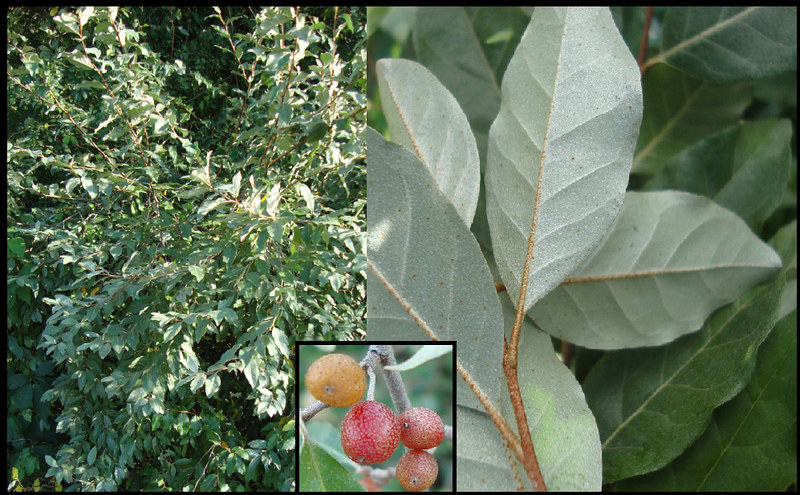
One of my favorite parts about this time of year is spotting the fruiting Autumn-olive (Elaeagnus umbellata) shrubs dotting the landscape just about everywhere on roadsides, riverbanks, and in open fields. Upon closer inspection, the leaves and fruits of Autumn-olive are flecked with shimmering silver sparkles that catch both the light and the eyes. Each September, I race songbirds to gather a bountiful harvest of berries for use in jam and fruit leather to enjoy throughout the winter months.
Beyond its striking beautiful appearance and delicious flavor, I am also intrigued by the complicated history of this plant, which was promoted by the U.S. Soil Conservation Service and U.S. Department of Agriculture throughout the 1900s, but is now considered invasive in Newaygo County, Michigan, and much of the U.S.
In order to understand the Autumn-olive’s journey, we must look back to its origins. Autumn-olive is native to eastern Asia, including China, Japan, and Korea. It was first introduced to North America in the early 19th century for various purposes including erosion control, wildlife habitat, and use as a garden ornamental. The planting of Autumn-olive was heavily promoted by government agencies, and by the late 20th century, it was widely planted along highways and in strip-mine restoration projects because of its ability to thrive in poor soil. Like the more familiar legume family (beans, peas, clover, etc.) Autumn-olive captures nitrogen from the air and fixes it into the soil, thus changing the soil chemistry and giving it a richer, more nutrient-dense composition.
In some cases, adding nutrients to depleted soil could be helpful for restoring ecosystems if the ecosystem in question depends on nutrient-rich soil. However, some ecosystems like oak savannas and pine barrens (both of which can be found in Newaygo County) are actually adapted to sandy, nutrient-poor soils, which the presence of Autumn-olive has been disrupting.
Today, when I hear others discussing Autumn-olive, there is often mention of “eradicating” or “decimating” its community, with the same vitriolic vigor that a frustrated farmer may employ when talking about their most prevalent weeds. While I share concern for native plant communities whose populations are declining as a result of Autumn-olive’s propensity to rapidly colonize and dominate open areas, I also wonder how the presence of Autumn-olive and other species deemed “invasive” may offer an invitation to rethink what constitutes “belonging”, a particularly salient discussion in a culture grappling with the pervasiveness of loneliness and alienation.
The term “invasive species” was coined by Charles Elton, a British zoologist and ecologist, in his 1958 book “The Ecology of Invasions by Animals and Plants.” Elton lived from 1900 to 1991, during a time of significant global changes, including two world wars and rapid technological advancements that facilitated increased global trade and travel. His work was influenced by the post-war emphasis on national security and the growing awareness of ecological issues, which likely contributed to the militaristic metaphor of “invasion” to describe the movement of species into new territories. This framing reflected the broader cultural anxieties of the mid-20th century, particularly concerns about “outsiders” and the preservation of perceived natural orders.
The movement of species across the globe did not begin with the mid-20th century concerns that shaped Elton’s work. Dramatic extinctions and shifts in species distributions have been recurring themes throughout Earth’s history. For example, the Great American Biotic Interchange, which occurred when North and South America connected via a land bridge about 3 million years ago.
This led to a massive exchange of plants and animals between the two continents, causing some species to flourish while others died out. Even more dramatically, the Great Oxygenation Event around 2.4 billion years ago filled Earth’s atmosphere with oxygen for the first time, fundamentally changing the planet’s life forms and causing widespread extinction of anaerobic organisms – the most dominant lifeforms of the time.
Notably, the shifts in species distribution and environmental changes throughout Earth’s history occurred gradually over thousands and even millions of years. In stark contrast, the rapid changes we’ve witnessed in the mere 250 years since the onset of industrialization have created an unprecedented situation with unpredictable outcomes. This accelerated pace of change raises concerns about stability and survival for many species, including ourselves. After all, human beings are equally dependent on our ecosystems as is “wildlife”.
The world around us is changing at an unprecedented rate, with climate change, the spread of non-native species, and human-induced alterations to hydrology and geology reshaping our landscapes. In light of this, it’s crucial that we do our utmost to slow the rate of change to lessen the load of rapid adjustment on our lands, our fellow lifeforms, and ourselves.
Additionally, I’d like to suggest that part of our responsibility in this moment of history is also to bear witness to these transformations and cultivate gratitude for the resilience of nature.
I find myself drawn to telling the stories of individual plant species like Autumn-olive and their journeys across time and space. There’s something deeply compelling about observing how different plants navigate the challenges of a rapidly changing world, adapting and persisting in ways both expected and surprising.
By taking the time to observe and learn about the plants around us—both native and non-native—we open ourselves up to a deeper appreciation of the intricate web of life that surrounds us within our beautiful, adaptive landscape.
Connected Resources: