Do you collect Styrofoam for recycling in your home? We do. Have for years.
By far the biggest contribution to the collection is from restaurants. We rarely finish the large portions served at most restaurants. So we ask for to-go containers (usually Styrofoam) that we dutifully rinse out after eating the leftovers at home. Then, we add the container to our growing Styrofoam collection.
Sometimes the pile takes over the storage closet where it is kept. Then what? Where to take it? There’s one recycling facility that accepts food use Styrofoam; its south of Grand Rapids (Atlas EPS, 8240 Byron Center Ave., Byron Center, MI 49315, 616-878-1568).
We drive up to Big Rapids and dump the Styrofoam at Recycle Mecosta for a small donation. (They are open on Saturdays and Mondays). But it’s a pain.
So, why can’t the restaurants stop using Styrofoam containers? And what’s the big deal about Styrofoam, anyway?
Styrofoam is cheap, lightweight, and easy to resource. It won’t seep grease or fluids and somewhat keeps your food insulated. But Styrofoam is also trash that won’t go away.
Most of the 3 million tons of Styrofoam produced each year goes to landfills where it takes roughly 500 years to break down. The production and use of Styrofoam releases toxic chemicals like benzene and styrene. As waste, it produces methane gas.
The Recycle, Reuse and Reduce committee of NCEC has initiated a campaign to discuss the possibility of reducing Styrofoam use in local restaurants. We are starting with a survey of restaurant owners regarding their willingness to change from Styrofoam. The hope is to offer other products that could be used and perhaps even purchased in bulk to reduce additional costs to the restaurants. A worthy effort, no doubt.
But let’s look at what we, as diners, could do to stem the use of disposable “to-go” containers.
-
Restaurant containers are generally disposable. The Styrofoam, cellulose, foil, and paper containers all take resources and production energy to produce. And they all take up space in our landfills. Even the sturdy plastic containers that could be reused, pose problems. So what’s the alternative? You could gorge yourself and eat the huge restaurant portion you were served,
-
-
or…
-
There is another way!
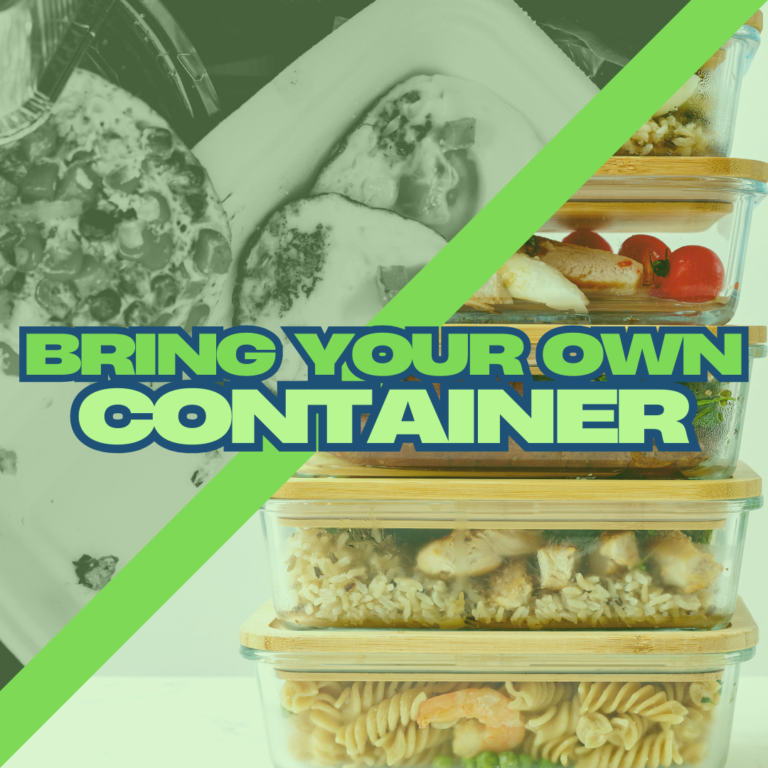
BYOC: Bring your own containers. Your own packaging that can be reused. You can choose safer packaging. You won’t be wasting the resources to make new containers every time and you won’t add to landfill waste. Here are some options:
-
-
-
Glass is your best bet. It’s a stable, durable material that will store your leftover pasta, meat, or salads. Think mason jars, old pickle jars, or even cute sets you can purchase if style is your thing. You can use glass over and over. Glass can easily be recycled if you need to dispose of it. Glass will not leach dangerous chemicals into your food.-There are some downsides of glass. It is somewhat bulky and you don’t want to heat glass in the microwave directly from the refrigerator (put your food on the plate before heating).
-
Silicone is another option. You can purchase collapsible containers that fit nicely in a purse or small tote, or consider the silicon sandwich bags which are even easier to pack. Silicone is heat-safe and long-lasting. It is also lightweight. The base material for silicone is silicon (sand), not petroleum. However, the production of silicone does require energy and uses some harmful chemicals to produce the flexibility of silicone. If you are curious, here is more info on silicone: https://www.gittemary.com/2020/07/the-impact-of-silicone-how-is-it-different-from-plastic.html)
-
Even your own plastic containers are better than Styrofoam or restaurant-provided containers. You are reusing the container, consequently reducing waste and production costs.
-
-
To review, the positives of BYOC (Bring Your Own Containers): Use of a safer, greener container without harmful chemicals like styrene, PFAS, BPA, reusable containers that reduce waste, reduce production cost of creating many disposable containers, saves time for your server and cost for the restaurant. Imagine the benefits if we normalized BYOC.