Bringing Nature Home-Creating Homegrown National Park

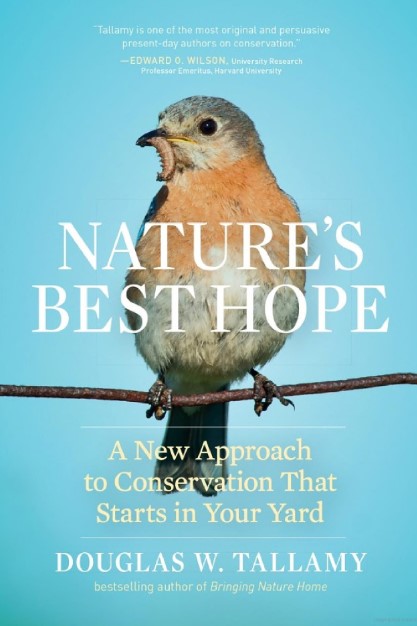
Image of Nature's Best Hope Cover (sky blue background with robin perched on twig, and white text font.)
Doug W. Tallamy outlines just how homeowners, businesses, and government entities can create Homegrown National Parks by planting up available green space with native plants.

Scroll to the end for the link to the
HGNP Landscaping Guides

Nature’s Best Hope by Douglas W. Tallamy is a carefully researched and thought-provoking book that has the potential to transform the way we think about the environment. This book is for anyone who is passionate about the environment and looking for practical ways to make a positive impact. Tallamy, a well-known ecologist and entomologist, is a trusted source when it comes to creating sustainable landscapes that support biodiversity. He is known for his research on the role of insects in the ecosystem, and how we can protect and preserve our local natural areas.


Nature’s Best Hope provides a comprehensive guide, detailing how we can protect and preserve our local natural areas, highlighting the vital role native plants play in promoting a healthy ecosystem. The book is full of practical tips and insights that can help individuals make a lasting impact on their environment. With this book, homeowners, business owners, and community leaders can take action towards building a thriving and sustainable environment.


The author also presents staggering evidence that our actions are critical in the fight to save our planet, and it’s up to us to make a real difference. He emphasizes the importance of planting native species in our own backyards and creating biodiverse ecosystems that support a wide variety of species.


Overall, Nature’s Best Hope is a well-written and informative read that offers practical tips and insights necessary for building a sustainable planet. It is an essential guide to help preserve our natural heritage and make real progress in the fight to save the planet. Every individual who is passionate about the environment should pick up a copy and be part of the solution.

Nature’s best hope can be found in your local library and via the Libby App.

SMALL EFFORTS BY MANY PEOPLE: 83% of land in the U.S. is privately owned. If we planted native on 50% of private land we would restore biodiversity…and we can do it starting NOW. We greatly encourage municipalities and public places to participate, but right NOW, each of us can take an ACTION. Let’s start planting.

Every square foot dedicated to lawn is a square foot that is degrading local ecosystems. Turfgrass offers no ecological benefits but is nice to walk on. Doug suggests that we reduce our lawns by half for walkways and paths that define beds, tree groves. Once you do this – please get on the HOMEGROWN NATIONAL PARK® MAP and encourage others to do the same!

Invasive plants are ecological tumors that spread unchecked into our local ecosystems, castrating the ecosystem’s ability to function. If every property owner removed the most egregious invasives, the goal of ridding the U.S. of these troublemakers, or at least reducing their seed rain to manageable levels, would be largely realized.

Doug’s research at the University of Delaware has shown that a few genera of native plants, or keystone genera, form the backbone of local ecosystems, particularly in terms of producing the food that fuels insects.

Landscapes that do not contain one or more species from keystone genera will have failed food webs, even if the diversity of other plants is very high. Check out our guide to container gardening with keystone plants that are native to your ecoregion!

To realize the ecological potential of our landscapes, most of us have to increase the abundance and diversity of our plantings. If you have one tree in your yard, consider adding two more. The idea is to plant groves of trees at the same density at which they occur naturally in a forest.

Research is showing that our porch and security lights are major causes of insect decline. Consider turning off your lights at night. Or use motion sensor security lights that light up only when an intruder enters your yard.  If nothing else, replace the white bulb in your lights with yellow tinted bulbs (yellow LED bulbs are the best). Yellow wavelengths are the least attractive to nocturnal insects.

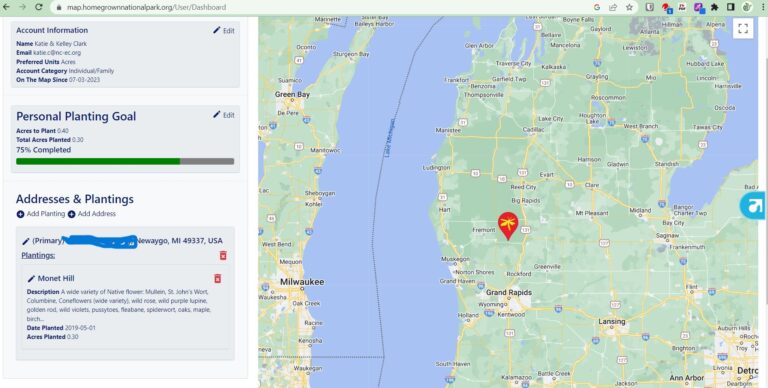
Be a role model for your neighbors. As you transform your property by planting natives in tasteful ways, it is likely your neighbors will follow suit. Whatever your size property, adding your neighbor’s yard to Homegrown National Park® MAP. The MAP is an interactive community-based visual tool that aggregates each individual contribution to planting native and measures progress towards our initial goal of converting 20 million acres of private land to productive ecosystems. For a Homegrown National Park On the MAP Sign, please visit the HNP Shop or: https://homegrownnationalpark.org/yard-sign.

  • Each year millions of toads, frogs, and other small creatures become trapped in our window wells where they slowly starve to death. Installing cheap window well covers can reduce these needless deaths to zero.

  • Set your mower height no lower than 3 inches. This will give you healthier, greener grass that requires less watering but also mows safely over a box turtle or toad! Try not to mow in the evening when many nocturnal species leave their hiding places.

  • Install a bubbler. Small water features with gentle gurgling sounds are irresistible to migrating and resident birds.

More than 90% of the caterpillars that develop on trees drop to the ground and pupate within the duff on the ground or within chambers they form underground.  It is best to replace lawn under trees with well-planted beds with groundcovers appropriate for your area. It’s easy, you can leave leaf litter under your trees, rocks, and old tree stumps, as well as plant wild ginger, foam flowers, wood poppies, native pachysandra, ferns, mayapples, etc.

Insecticides and herbicides are antithetical to the goals of HOMEGROWN NATIONAL PARK.  Less evident is that fertilizers are also unnecessary.  Creating soils rich in organic matter is entirely sufficient for healthy plants.

Many homeowners believe they cannot use more native plants in their landscape because of rules developed and enforced by their township, civic association or homeowner association.   These rules are likely dated as they were created when we didn’t know then what we do now. HOMEGROWN NATIONAL PARK includes Start a new HABITAT® in how we landscape.  The “new luxury landscape” is one of meadows and/or formal native planted gardens – it is no longer rolling green lawns.

Toggle Content

Resources:

Leave a Reply

Your email address will not be published. Required fields are marked *

Get In touch

Birds eye view of green forest meeting blue lake background. White NCEC logo and font.

(231) 519-3419

Address: 490 Quarterline St, Newaygo, MI 49337

Email buzz@nc-ec.org

More Posts:

Have a Fire-Safe Summer

“But surely a few logs of my firewood from home won’t hurt anything if I take them camping with me!!! I don’t want to buy firewood when I already have a bunch!”

It’s easy to overlook the creatures we don’t see very often. But lots of little critters feed on and live in dead wood and not just rotting wood, even dry firewood! The culprits of deadly Oak Wilt, the Emerald Ash Borer, and the invasive Asian Longhorned Beetle are just some of the critters known to hitch a ride on firewood.

Read More »

Plant THIS Not THAT

Spring is the time when we rethink our whole existing gardens. The more we understand how much wildlife, including our essential pollinators, struggle with traditional constrained lawn and manicured gardens full of exotic plants, the more we might be motivated to change things up a bit!

Read More »

Planting for Pollinators: A Conversation with Sarah Pregitzer

In preparation for the upcoming growing season, we interviewed NCEC board chair and Master Naturalist Sarah Pregitzer, who has a wealth of knowledge to offer about the role of pollinators in our ecosystem as well as easy ways to get started with planting for pollinators in your yard or in the community.

Read More »