Planting for Pollinators: A Conversation with Sarah Pregitzer

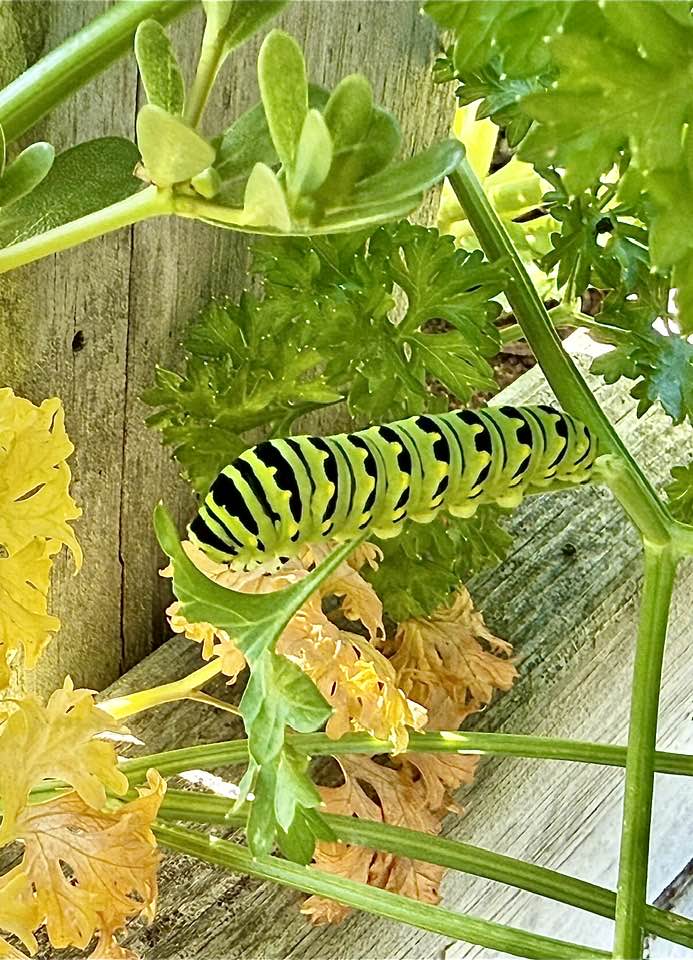
The tale of the hungry, hungry caterpillar (black swallowtail edition): we are always delighted to see something like this show up in our yard. The first black swallowtail caterpillar seen here this year, and it’s been very rare in the past. Photo Credit & Story by Randy Butters
Pollinator initiatives have been taking off all over the nation. Why are people getting interested in Planning for Pollinators?

I think most people who’ve been around for a while have noticed that there aren’t as many bugs as there used to be. I remember seeing 150 tiger swallowtails in a puddle, and you just don’t see that anymore. I haven’t seen a luna moth in maybe 15 years? They’re just not around like they used to be. 

And of course, one in three bites of food we eat depends directly on pollinators. Really the only things that don’t are the grasses like wheat, that are pollinated by wind, and the things that can eat grasses, like sheep and goats and cows. But all of our fruits and vegetables have to be pollinated.

Who are the “biggest” pollinators in the Newaygo County Region? ​

That’s hard to know, but if I were to guess, I’d say probably hover flies. They can travel longer distances than most other pollinators, which is an  advantage to them in a fragmented habitat. After that I’d think the native bees are some of the most numerous, especially the common bumblebee. There are way fewer honeybees than there used to be. Some folks, myself included, keep them for pollinator services, but they don’t outnumber the native bees. 

There are SO many hoverfly species, their names are so cool, and so many are mistaken for bees. Photo Credit & Comment by Randy Butters
What can I do to support pollinators in my yard?

Give them places to live their lives! Our pollinators need native plants to collect nectar and pollen from. A lot of non-native plants, they don’t recognize as food sources.

Of course, the pollinators also need somewhere to get a drink. You can provide this with a bird bath, or a bowl sunk into the ground, or even a small depression you dig out and line with plastic or clay. Just make sure to keep some rocks in there: pebbles, or flat river stones, will give them a place to climb out.

The last thing our pollinators need is nesting space. The mason bees need wood to burrow into, so I like to keep some wood in my garden, like an old piece of driftwood. And our bumblebees need bare ground to burrow into, so in year two or three, pull back some of that mulch under your tall plants (like asters) and just leave the soil exposed. 

And please don’t spray pesticides or buy “pest-resistant” plants. Plants labeled as “pest-resistant” contain Neonicotinoid, which harms vulnerable insect communities.

Which plants should I plant?

There is a great native plant for every circumstance! 

There are three primary things you should consider: your soil, the amount of moisture it holds, and the light conditions in the garden space. Nurseries often have catalogues that will show you each plant’s requirement for those elements – they should be willing to give you one if you ask! We like Prairie Moon from Minnesota, and StanTec from Michigan.

You may want to consider bloom time – picking a few plants that bloom in each part of the growing season keeps your garden colorful, and can help support pollinators in the fall, when they are preparing for winter and flowers are getting much more scarce. 

If you want a specific pollinator, you can plant their host plant. Clearwing, or hummingbird moths, need snowberry bushes to reproduce, and I love those little guys. So I planted one, then another snowberry bush, and within a couple years of the second planting I had clearwing moths all over those bushes. And of course, the local famous pollinator, the karner blue butterfly’s caterpillars need our native lupine, now called sundial lupine. They won’t eat anything else. Beware of horticultural strains of lupine, or imports from the Western USA – it can hybridize with our native lupine, but the caterpillars can’t live on the leaves from that plant. 

Randy captures a great image of the endangered Karner Blue Butterfly. However, the spotteed knapweed (an agressive invasive plant) can trick her to lay her eggs on it if her needed host plant the Sundial Lupine is not available. Her progeny will not survive. Photo Credit-Randy Butters

How should I prepare my space for planting?

I don’t recommend digging up the space you want to plant – this gives the seeds already stored in the soil a chance to germinate, and they may or may not be what you’re looking for. Instead, trim any grass down as low as you can and cover it to kill it. Newspaper (5-7 layers deep!) can be left in place and covered with mulch, while black plastic tarps should be removed to avoid suffocating the soil. If you use the newspaper/mulch combination, you shouldn’t have to really weed for at least 3-5 years. I never recommend landscape cloth, as it is basically plastic you’re putting in your soil. You don’t want that in your own food, well neither do the pollinators. 

I also like to edge my gardens. A square-nosed shovel works just fine for the task, just dig straight down and towards your flowerbeds, making a sort-of triangle of removed earth. This “air trench” will stop the turf grass from sending runners into your garden.

Now, for Your Questions!

Is there something you’ve always wondered about pollinators? Do you need ideas or advice for planting in your own yard? Fill out our online form between now and the end of February 2026 to submit your questions. We’ll be back in April with the second part of the interview and Sarah will answer YOUR inquiries about pollinators, gardening with native plants, how-to advice, and any other burning curiosities about the role of pollinators in Newaygo County’s ecosystems.

Connected Resources:

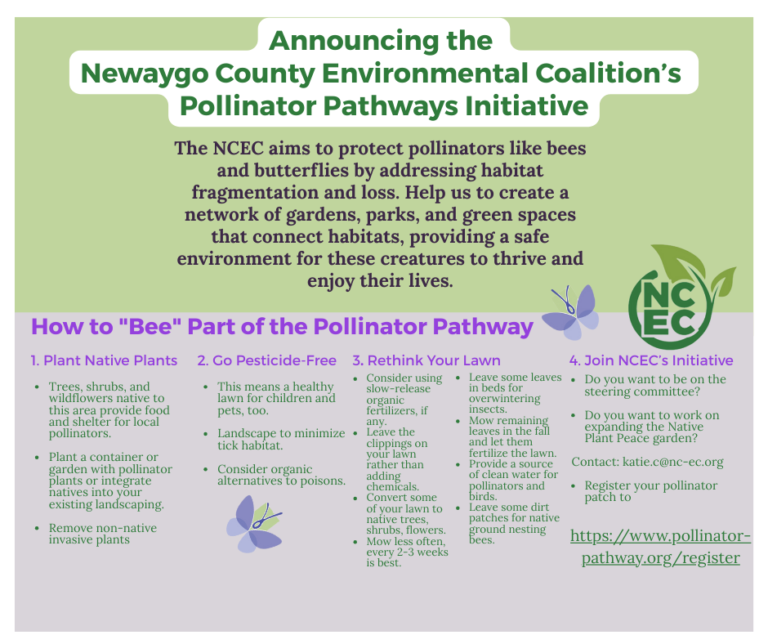
Join the NCEC Pollinator Pathway Initiative! Contact katie.c@nc-ec.org

Leave a Reply

Your email address will not be published. Required fields are marked *

Get In touch

Birds eye view of green forest meeting blue lake background. White NCEC logo and font.

(231) 519-3419

Address: 490 Quarterline St, Newaygo, MI 49337

Email buzz@nc-ec.org

More Posts:

Fall Cleanup with Pollinators in Mind

The late-August chill prompted me to start thinking about fall clean-up in the garden. For many of us, tending our vegetable and flower beds, wild corners, and lawns will still be part of our rhythms in the months ahead as we prepare for winter’s rest.

Autumn is the perfect time for planting new perennials, dividing crowded clumps, and scattering seeds that need the cold season to wake them in spring. Yet as the chore list grows, so does another question: how do we balance our own labors with care for our other-than-human neighbors who share these gardens as food pantries, nurseries, and shelters?

Read More »

Returned and Restored

A cloud of road dust blanketed the car behind me from my excited acceleration as I passed the Newaygo Prairie Nature Sanctuary. Ignition time was in less than an hour. This was my very first burn.

Read More »

April is Vernal Pools Month in Newaygo County!

“Vernal Pools are like our Coral Reefs of the Forest,” states Katie, Vice Chair and Program Manager of the Newaygo County Environmental Coalition (NCEC). “They are small, important wetlands that appear in spring and dry up during the fall.  They are ideal breeding grounds for a variety of amphibians and invertebrates that would be vulnerable to lake or stream fish; the fairy shrimp, wood frogs, spotted and blue-spotted salamanders can only breed in Vernal pools. They even travel back to their birth Vernal pool to spawn.”

Read More »